We use affiliate links to run our site. When you buy through links on our site, we may earn an affiliate commission, without any added cost to you. Learn more
Snakes have captivated human curiosity for centuries, with their slithering bodies, mesmerizing patterns, and enigmatic behaviors.
These remarkable reptiles have evolved to thrive in diverse environments across the globe, making them a subject of fascination and awe.
In this article, we delve into the intriguing world of snakes and uncover 15 captivating facts that will leave you spellbound.
So, let’s shed our preconceptions and embark on a journey through the mesmerizing realm of these extraordinary creatures.
Interesting Snake Facts
Here are 15 interesting facts about snakes:
1. Snakes Have Existed for Over 100 Million Years — And Evolved from Lizards
Fossil evidence from the Cretaceous period confirms that snakes descended from burrowing lizards.
A 2020 study published in Nature Communications traced the earliest snake ancestors to around 128 million years ago. Their limbless form wasn’t a loss — it was an adaptation for stealth, burrowing, and navigating tight spaces.
Modern snakes like the blind snake still retain vestigial pelvic bones, a living fossil of their evolutionary past.
2. There Are Over 3,600 Snake Species — From 4-Inch Thread Snakes to 30-Foot Pythons
The thread snake (Leptotyphlops carlae) measures just 4 inches — smaller than your smartphone. Meanwhile, the reticulated python (Malayopython reticulatus) can reach 30 feet and weigh over 300 pounds. This diversity spans 20+ families, including sea snakes, vipers, colubrids, and boas.
The IUCN Red List currently tracks 3,600+ species — and new ones are still being discovered in remote jungles and caves.
3. Snakes Live on Every Continent Except Antarctica — Thanks to Extreme Adaptations
The sidewinder rattlesnake (Crotalus cerastes) survives in 120°F desert heat by moving sideways to minimize contact with hot sand. The sea krait (Aipysurus laevis) dives 100+ feet to hunt eels, holding its breath for up to 8 hours.
Even the Arctic’s coldest regions host the common European adder — proof that snakes can thrive where few other reptiles dare.
4. Snakes “Smell” With Their Tongues — Using a Special Organ Called Jacobson’s Organ
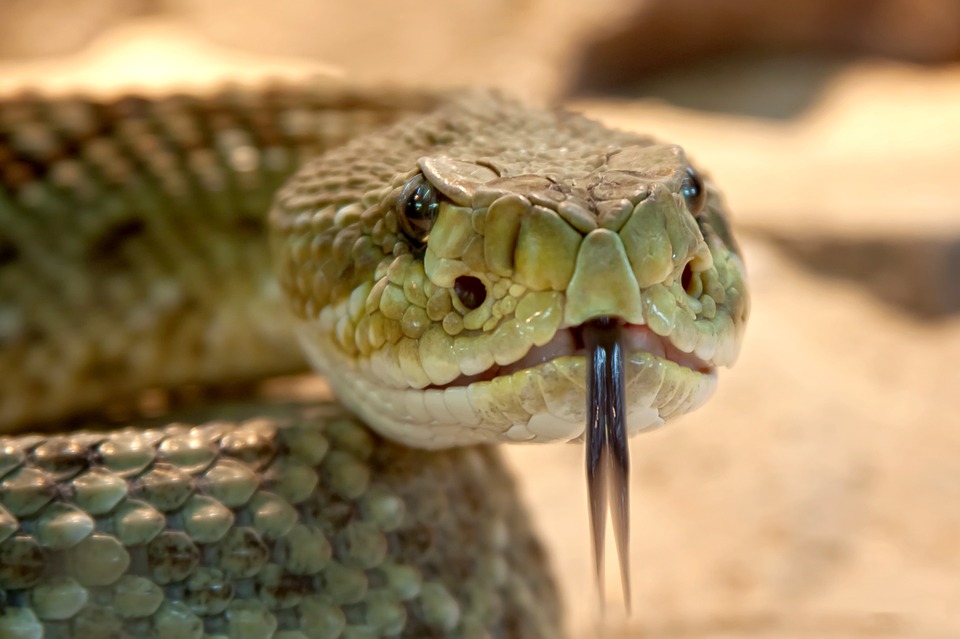
Snakes don’t smell like humans. Instead, they flick their forked tongues to collect airborne chemical particles, then transfer them to Jacobson’s organ (vomeronasal organ) in the roof of their mouth.
This lets them “taste the air” in stereo — detecting prey direction with 90% accuracy, according to a 2019 study in the Journal of Experimental Biology.
5. Their Forked Tongue Isn’t for Intimidation — It’s a Precision Navigation Tool
Each fork of the tongue samples air from slightly different angles. The brain compares the intensity of scent molecules on each side to triangulate prey location.
This is why snakes often flick their tongues repeatedly — they’re building a 3D scent map. It’s not magic — it’s biomechanical genius.
6. Only 15% of Snakes Are Venomous — And Not All Venom Is Lethal
Of the 3,600+ species, roughly 600 are venomous — and only 200 can seriously harm humans.
Venom evolved for prey immobilization, not defense. For example, the king cobra’s venom targets the nervous system, while the Gaboon viper’s targets blood clotting.
Non-venomous snakes like the corn snake rely on constriction — wrapping around prey and suffocating it in seconds.
7. Snakes Shed Their Skin to Grow — And Sometimes to Heal or Escape Predators
Ecdysis (shedding) happens every 2–8 weeks, depending on age, species, and environment. Young snakes shed more often — sometimes monthly — as they grow rapidly.
Shedding also removes parasites and damaged skin. In captivity, stress or poor humidity can cause incomplete sheds — a common health issue for pet snakes.
8. Snakes See Motion, Not Detail — But Compensate With Heat-Sensing Pits
Most snakes have poor visual acuity — they can’t focus on stationary objects. But pit vipers (like rattlesnakes) have infrared-sensing pits between their eyes and nostrils, detecting heat signatures from 12 inches away.
This lets them “see” warm-blooded prey in total darkness — a superpower evolution perfected over millions of years.
9. “Flying” Snakes Can Glide Up to 100 Feet — By Flattening Their Bodies
The paradise tree snake (Chrysopelea paradisi) flattens its body into a concave “wing” and undulates mid-air to glide between trees.
A 1994 study by George Washington University showed they can cover 100+ feet in a single glide — not flight, but controlled aerial locomotion. No other snake can do this.
10. Snake Charming Is Real — But It’s Not Magic, It’s Behavioral Science
Snake charmers in India and Morocco use rhythmic movements and flutes — but snakes can’t hear music. They respond to vibrations and visual cues.
The cobra’s “dance” is a defensive posture — it’s tracking the charmer’s movements, not the music.
The practice is declining due to animal welfare laws, but it remains a cultural artifact rooted in understanding snake behavior.
11. Snakes Are Vital Ecological Regulators — Controlling Rodents, Insects, and Disease
A single rat snake can eat 50+ rodents per year — preventing crop damage and disease spread. In Australia, the eastern brown snake helps control invasive mice.
Snakes are also prey for eagles, mongooses, and even other snakes — making them keystone species in food webs. Remove them, and ecosystems collapse.
12. The Titanoboa Was the Largest Snake Ever — 42 Feet Long and 2,500 Pounds
This prehistoric giant ruled South American rainforests 60 million years ago. Fossils found in Colombia show it could swallow crocodiles whole. Its extinction coincided with global cooling — proof that even apex predators can’t survive climate shifts.
Today’s largest snakes (anacondas, reticulated pythons) are dwarfed by this ancient behemoth.
13. Snakes Symbolize Transformation — From Medicine to Mythology
In Greek mythology, the caduceus (snake-entwined staff) symbolizes healing — still used by modern medicine. The ouroboros (snake eating its tail) represents renewal and eternity — a nod to shedding skin. In Hinduism, snakes (nagas) guard sacred knowledge.
These symbols persist because snakes embody change, danger, and rebirth — universal human themes.
14. Some Snakes Give Birth to Live Young — A Rare Trait in Reptiles
About 30% of snakes are viviparous, giving birth to live offspring instead of laying eggs.
The common garter snake (Thamnophis sirtalis) gives birth to 10–40 live babies after a 3-month gestation. This adaptation protects young from predators and cold climates — a survival advantage in northern regions.
15. Snake Venom Is Revolutionizing Medicine — From Heart Drugs to Painkillers
Venom from the Malayan pit viper led to the development of tirofiban, a drug for heart attacks. The Gila monster’s venom inspired exenatide, used to treat type 2 diabetes.
Researchers at the University of Queensland are testing snake venom compounds for cancer treatment. What kills can also cure — and science is just beginning to unlock its potential.
Final Thoughts: Why Snakes Matter More Than You Think:
Snakes aren’t just creepy crawlies — they’re ecological linchpins, medical marvels, and evolutionary wonders. Understanding them isn’t just fascinating — it’s essential for conservation, medicine, and our own survival.
Share this article with a friend, teacher, or student. And if you want to dive deeper, explore our sister articles: “10 Best Pet White Snakes,” “Why Do Snakes Yawn?,” and “Poison vs Venom: What’s the Real Difference?”
As we come to the end of our journey through the captivating world of snakes, we hope you’ve gained a newfound appreciation for these remarkable creatures.
If you found this article fascinating, don’t hesitate to spread the word. Share it with your friends, family, or anyone who might be intrigued by the secrets of the serpents.
About the author
Prasenjit Saha holds a Bachelor of Science in Zoology from the University of North Bengal. With over 10 years of experience in wildlife education and conservation. His expertise spans animal behavior, toxin biology, and public safety in natural environments. Prasenjit has contributed to multiple blog sites and has written more than 700 articles. He is committed to making complex biological concepts accessible to the general public.
Frequently Asked Questions:
Are all snakes venomous?
No. Only about 15% of snake species are venomous — and most avoid humans. Non-venomous snakes like garter snakes and corn snakes are harmless and beneficial.
How do snakes move without legs?
They use muscular contractions and specialized belly scales to push against surfaces. Some use sidewinding (desert snakes), others use concertina motion (tree snakes), and sea snakes undulate like eels.
Can snakes hear?
They lack external ears but detect ground vibrations and low-frequency sounds through their jawbones. They’re not deaf — just differently tuned.
How long can snakes go without eating?
Some species (like pythons) can survive 6–12 months without food by slowing metabolism. In captivity, this is unhealthy — they need regular feeding.
Can snakes blink?
No. They have a transparent scale called a “spectacle” that covers and protects their eyes. It sheds with their skin — so they never need to blink.
—
© 2026 Factsovia.com. All rights reserved.
Amazon and the Amazon logo are trademarks of Amazon.com, Inc, or its affiliates.
This site uses affiliate links. We may earn a commission at no extra cost to you. Learn more.
Amazon and the Amazon logo are trademarks of Amazon.com, Inc, or its affiliates.