
We use affiliate links to run our site. When you buy through links on our site, we may earn an affiliate commission, without any added cost to you. Learn more
Let’s be real for a second. When you hear “Albert Einstein,” what pops into your head? Is it the wild, gray mane of hair? That iconic photo of him sticking out his tongue? Or maybe just the word “genius” plastered next to E=mc²?
We’ve all been there. We turn Einstein into a cartoon—a superhero of thought who floated above the rest of us, mere mortals. But here’s the kicker: He was a mess. A beautiful, brilliant, stubborn, and sometimes hilariously flawed human being.
If you think you know Einstein, buckle up. We’re about to peel back the layers of history and look at the man behind the myth. Did you know he almost became the President of Israel? Or that someone literally stole his eyes? Let’s dive into the weird, wild, and wonderful world of Albert Einstein.
1. The Late Bloomer Who Bombed School (Sort Of)
We’ve all heard the myth: Einstein failed math. I hate to burst that bubble, but it’s completely false. In fact, by 15, he had mastered differential and integral calculus.
However, he did hate the rigid, military-style discipline of German schools. He clashed with his teachers so much that one famously told him, “Nothing good will ever come of you.”
Why “Einstein = Bad Student” Is a Lie
Here is the nuance: He failed the entrance exam for the Swiss Federal Polytechnic School. But wait—before you judge, he was only 16, and he aced the math and science sections. He failed the botany, zoology, and language parts. He was a specialist, not a dunce. Think of it like a race car driver failing a test on parallel parking. It’s just not his domain.
2. The Year Everything Changed (His “Miracle Year”)
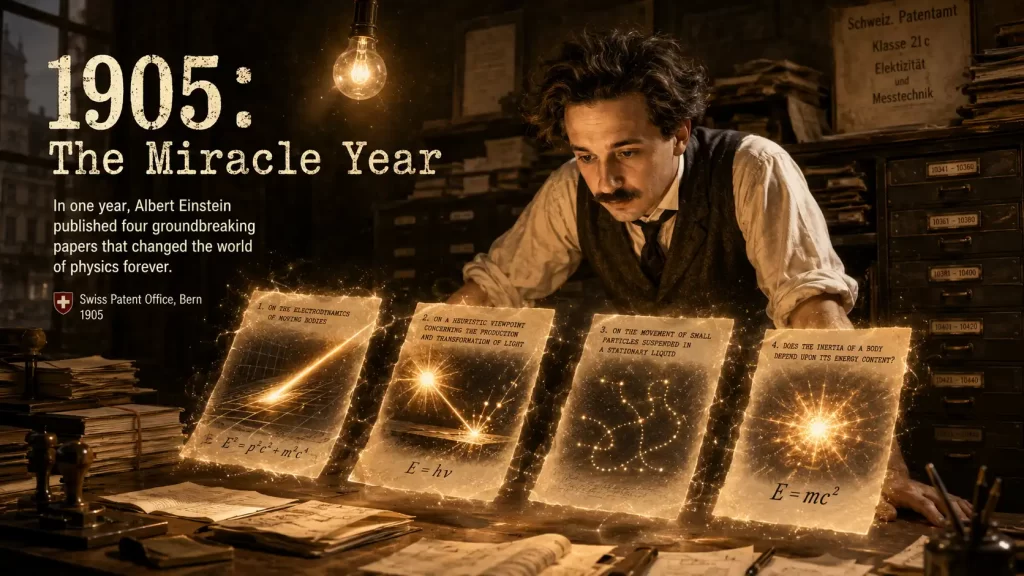
Imagine having the best year of your career. Now imagine having four of the best years of anyone’s career in just 12 months. In 1905, Einstein was a 26-year-old patent clerk (a boring desk job reviewing other people’s inventions). While the world was sleeping, he was unleashing a scientific tsunami.
Four Papers That Rewrote Physics
In this single year, he published four groundbreaking papers: on the photoelectric effect (quantum theory), Brownian motion (proving atoms exist), Special Relativity (changing time and space), and E=mc². To put that in perspective, that’s like a cashier at Walmart secretly writing War and Peace, The Bible, and Harry Potter in their lunch breaks. Insanity, right?
3. He Didn’t Invent the Atomic Bomb (But He Made It Possible)
This is a huge one. A lot of people blame Einstein for Hiroshima. But here is the truth: Albert Einstein had nothing to do with the Manhattan Project’s engineering. He couldn’t even get security clearance to work on it because the FBI thought he was a socialist risk.
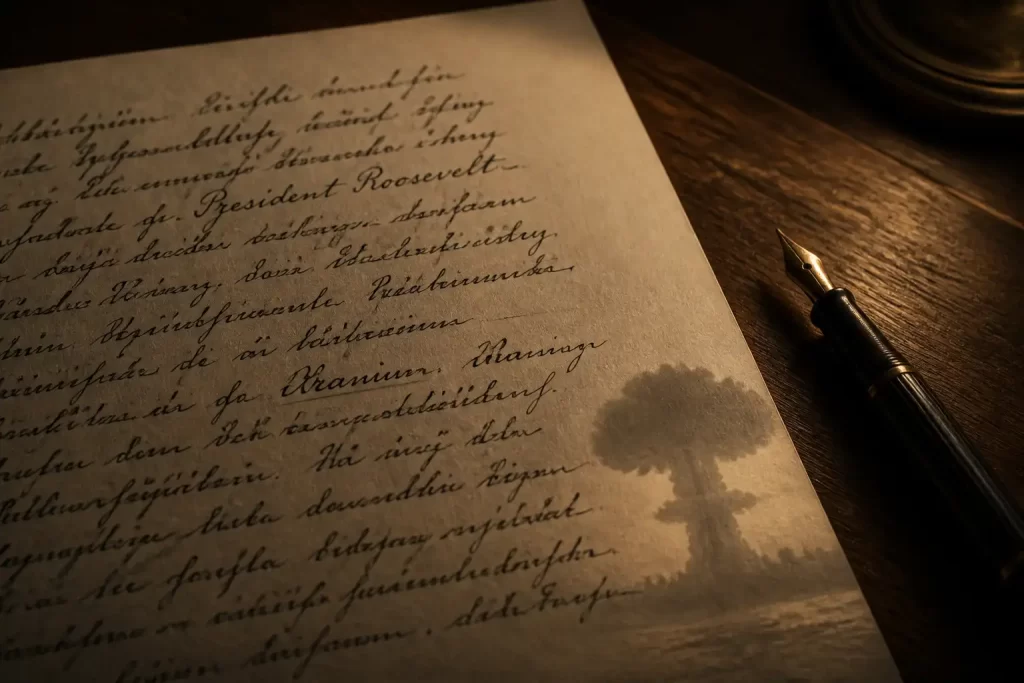
However, he did write a letter to FDR (President Roosevelt) warning that the Nazis might build one first. That letter kicked off the race. Years later, when he heard the bomb was used on Japan, he reportedly said, “Woe is me.” He spent the rest of his life campaigning for nuclear disarmament. A tragic irony, isn’t it? The man who unlocked the atom spent his final years trying to lock it back up.
4. That Equation You’ve Seen? It’s Actually Incomplete
You’ve seen the t-shirt. E=mc². It looks so neat, so final. But Einstein actually wrote it differently in his original 1905 paper.
The real, full equation includes a square root and a momentum term. It looks more like E² = (mc²)² + (pc)². We only use the simplified version when the object is standing still. So, next time you see a tattoo of the simple equation, just whisper to yourself, “That’s the lazy version.”
5. His Eyes: A Gift for Science (Literally)
This is where things get macabre. When Einstein died in 1955, a pathologist named Dr. Thomas Harvey took… liberties. Without asking the family first (okay, he stole them), Harvey removed Einstein’s brain and his eyes.
Yes, you read that right. The brain is famous, but the eyes are a weird detail. Harvey gave the eyes to Einstein’s eye doctor, Henry Abrams. Why? To see if the “genius” had a unique ocular structure. Spoiler alert: They looked normal. Where are they now? Locked in a safe deposit box in New York City. Creepy, or fascinating? You decide.
6. The Compass That Changed Everything
Every superhero has an origin story. For Einstein, it wasn’t a radioactive spider; it was a compass. When he was five years old and sick in bed, his father showed him a simple magnetic compass.
He was mesmerized. Here was an empty space, a vacuum, and yet the needle moved toward the north. Something was making it move. “I trembled and grew cold,” he later said. From that moment on, he knew he wanted to understand the invisible forces of the universe. A five-year-old with a cold started the revolution.
7. The President Who Said No
This sounds like a joke, but it’s 100% real. In 1952, after the death of Israel’s first president, Chaim Weizmann, the Israeli government offered the presidency to Albert Einstein. The President!
Einstein declined. He wrote a letter saying, “I am deeply moved by the offer… but I have neither the natural ability nor the experience to deal with human beings.” Think about that. A man who could unravel the fabric of the universe felt he wasn’t qualified to handle office politics. It makes you wonder: Are the smartest people just too smart for the corner office?
8. The “Biggest Blunder” That Wasn’t a Blunder
Einstein was a genius, but he was also a stubborn mule. When he created his General Theory of Relativity, the math kept telling him the universe was expanding. But Einstein believed the universe was static—eternal and unchanging. So, he fudged the numbers. He added a “cosmological constant” (a fudge factor) to stop the expansion.
The Cosmological Constant Returns
Then, Edwin Hubble discovered the universe is expanding. Einstein called his fudge factor his “biggest blunder.” End of story? Nope. Fast forward to the 1990s. Scientists discovered Dark Energy. Guess what fits that perfectly? Einstein’s “blunder.” The cosmological constant is back. So, Einstein was wrong about being wrong. Your head spinning yet? Mine is.
9. A Sailing Disaster (The Man Who Couldn’t Swim)
For all his brainpower, Einstein had zero practical intelligence. His hobby was sailing. But here’s the punchline: He couldn’t swim. And he was a terrible sailor.
He would take a small boat out on a lake near Berlin, often forgetting to bring a life jacket. When the wind died, he would just… sit there. He’d take out a book and wait to be rescued. He capsized so often that neighbors knew to keep an eye on him. It’s a perfect metaphor: He navigated the cosmos perfectly but couldn’t steer a dinghy in a pond.
10. The Brain Thief (A Post-Mortem Mystery)
We talked about the eyes, but the brain itself has a wild story. Dr. Harvey, the thief, took Einstein’s brain, chopped it into 240 blocks, and spent 40 years waiting for “science to catch up.”
He drove across America with jars containing pieces of the brain in the trunk of his car. Eventually, studies showed that Einstein’s brain had an unusually large corpus callosum (the bridge connecting the two hemispheres). Basically, his left and right brains talked to each other better than yours or mine. But did that make him a genius? Or did being a genius make his brain change shape? The chicken-or-egg debate continues.
11. Love, Marriage, and a Weird Reward
Einstein’s love life was… complicated. He married Mileva Maric, a fellow physicist. But things soured fast. They had a daughter (Lieserl) who was given up for adoption (we don’t even have a photo of her).
When they divorced, Einstein made a strange promise. He told Mileva that if he ever won the Nobel Prize, he would give her the prize money. She agreed. In 1922, he won the prize—not for Relativity (which was still controversial), but for the Photoelectric Effect. He handed over the cash. So, in a way, Einstein bought his freedom from a failing marriage with a Nobel Prize. That has to be the most expensive divorce settlement in physics history.
12. Why He Hated “Spooky Action at a Distance”
Einstein is the grandfather of modern physics, but he hated the weirdness of Quantum Mechanics. Specifically, he hated “quantum entanglement”—the idea that two particles can be linked across the universe so that touching one instantly affects the other.
He called it “spooky action at a distance.” He refused to believe God played dice with the universe. He wanted a reality that made sense, where everything had a local cause. Ironically, scientists have now proven “spooky action” is real. Poor Albert. He found the rules, then got mad at the rules.
13. The Simple Gift He Gave a Bellboy
Here is a story that will restore your faith in humanity. Einstein was once traveling in Japan. A delivery boy (a bellhop) brought him a package. Instead of reaching for his wallet, Einstein found he didn’t have any change for a tip.
Thinking quickly, he took out a pen and wrote two things on a piece of hotel stationery: “A quiet and modest life brings more joy than a pursuit of success” and “Where there’s a will, there’s a way.” He told the boy, “Keep these; they might be worth something someday.”
In 2017, that single tip note sold at auction for $1.5 million. Talk about a tip. I wonder if that bellboy ever cashed out.
14. He Failed His First College Entrance Exam
We touched on this earlier, but it deserves its own spotlight. At 16, Einstein failed the liberal arts portion of the ETH Zurich entrance exam.
He was 16, spoke slowly (he took a long time to form sentences as a child), and bombed the history and language tests. His teachers told his parents to make him learn a trade. Can you imagine the guidance counselor telling young Einstein, “Maybe consider plumbing?” He had to go to a special school for a year to catch up. If you’ve ever failed a test in your life, remember: The guy who redefined time couldn’t remember dates in a history book.
15. The Riddle of Time (Why Your GPS Works)
Let’s bring it home. You use Einstein every day, and you don’t even know it. The GPS in your phone.
According to General Relativity, time moves faster where gravity is weaker. Up in space (for satellites), time moves faster than it does on Earth. But also, because of Special Relativity (speed), time moves slower for the satellites because they are moving fast relative to the Earth.
The net result is that a satellite’s clock gains about 38 microseconds per day. If we didn’t correct for Einstein’s equations, your GPS would be off by about 7 miles within a single day. You’d be driving into a river while looking for a Starbucks. So yes, Einstein is the reason your Uber shows up.
Conclusion: The Patches on His Coat
So, what have we learned? Albert Einstein wasn’t a marble statue on a pedestal. He was a man who couldn’t swim, who failed exams, who had a stolen brain, and who sold a Nobel Prize to get a divorce. He was a pacifist who made the bomb possible, a man who hated spooky science that turned out to be true, and a bad sailor who loved the quiet of the ocean.
He once wrote: “The monotony and solitude of a quiet life stimulates the creative mind.” In a world screaming for your attention, maybe the most “Einstein” thing you can do today is just… sit on a leaky boat, stare at a compass, and ask a stupid question. Because that’s where genius really lives. Not in the hair, but in the humility to be wrong.
FAQs
1. Did Einstein really have a learning disability?
While he spoke slowly and was thought to be “slow” as a child, historians largely disagree that he had dyslexia or autism. He simply rejected rote learning. He did have a unique brain structure, but that doesn’t equate to a disability.
2. What happened to his daughter, Lieserl?
Lieserl was born in 1902 to Einstein and Mileva Maric before they were married. Her fate is unknown. Some records suggest she died of scarlet fever in infancy, while others believe she was given up for adoption. No letters from her exist after 1903.
3. Where is Einstein’s brain right now?
Most of it is preserved in slides at the Mütter Museum in Philadelphia and the National Museum of Health and Medicine in Washington, D.C. The rest remains in the possession of private collectors and the heirs of Dr. Thomas Harvey.
4. Could Einstein actually play the violin?
Yes! And quite well. His mother was a pianist, and he started playing at age six. He once said that if he hadn’t become a scientist, he would have been a musician. He used music (especially Mozart) to solve complex physics problems, claiming it helped him “connect to the harmony of the universe.”
5. Did Einstein believe in God?
This is tricky. He didn’t believe in a personal God who answers prayers (“not a God who concerns himself with the fate of human beings”). However, he deeply believed in “Spinoza’s God”—the idea that God exists in the harmony of nature and the laws of the universe. He often called the universe “God’s riddle.”
Amazon and the Amazon logo are trademarks of Amazon.com, Inc, or its affiliates.