We use affiliate links to run our site. When you buy through links on our site, we may earn an affiliate commission, without any added cost to you. Learn more
Let me ask you something. When was the last time you truly noticed a jaguar?
Not a leopard. Not a cheetah. An actual Panthera onca.
Most people scroll past jaguar photos thinking, “Nice spots, big cat, moving on.” But that’s like calling a Ferrari “a red car.” You’re missing the insanity underneath the hood.
Today, I’m giving you 25 interesting facts about the jaguar that will rewire your brain. By fact #5, you’ll never look at a turtle the same way again. By fact #12, you’ll want to buy waterproof boots.
Let’s sink our teeth in.
1. Size & Strength Facts
Fact #1: The Third-Largest Big Cat on Earth
Tigers are #1. Lions are #2. Jaguars take the bronze medal. Males average 100–250 pounds, but in Brazil’s Pantanal region, some giants push 300 pounds. That’s heavier than most professional wrestlers.
Fact #2: They’re Built Like Powerlifters, Not Marathoners
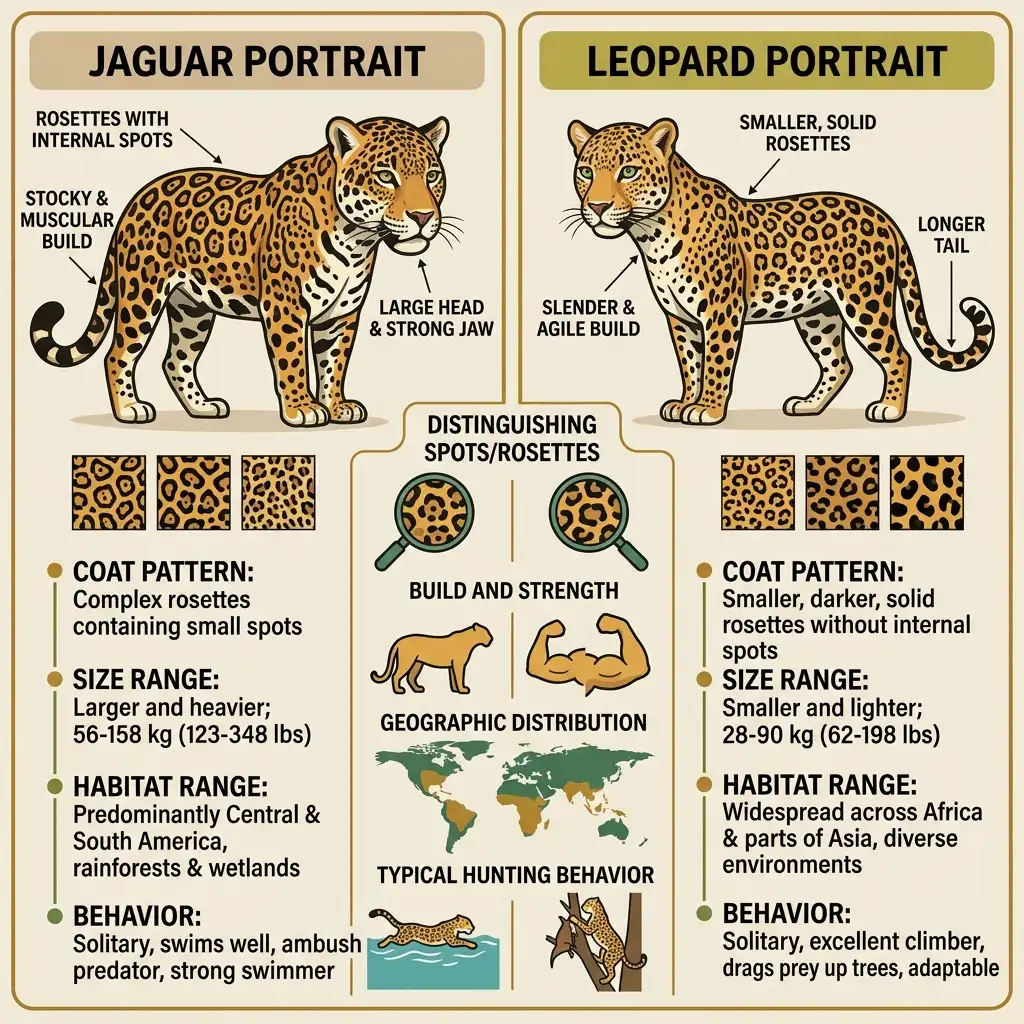
Unlike leopards (lean and lanky), jaguars have thick, stocky bodies, broad heads, and short, muscular legs. Think of a leopard as a basketball player. The jaguar is an NFL linebacker.
Fact #3: How Long Are They?
From nose to tail tip: up to 6 feet (1.85 m). Their tail alone adds 30 inches—used for balance when climbing and swimming.
Fact #4: Females Are Smaller but Fiercer
A 130-pound female jaguar can drag a 500-pound cow carcass through mud. No gym membership required.
2. Jaw & Bite Force Facts
Fact #5: The Strongest Bite of Any Big Cat (Relative to Size)
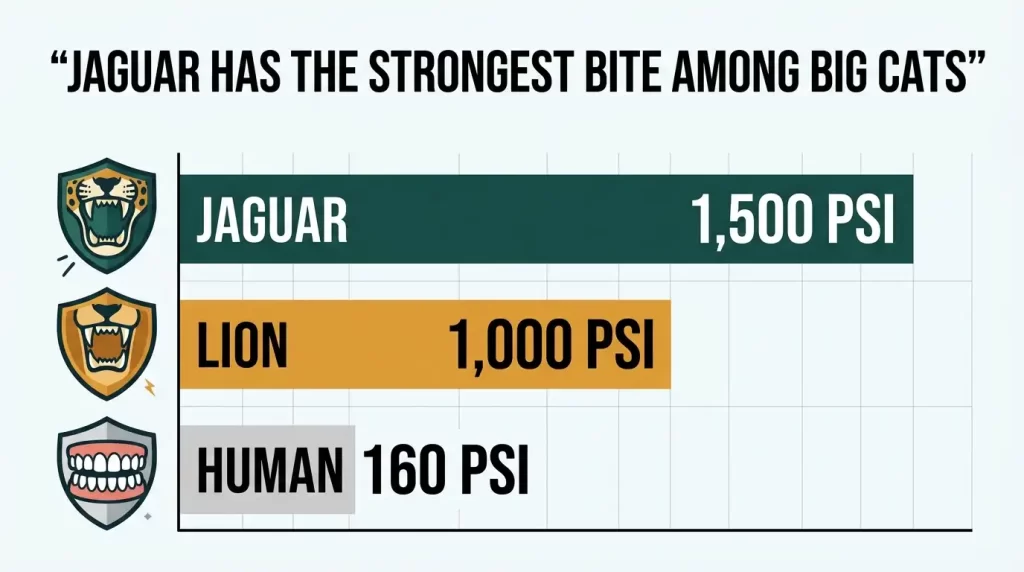
Here’s one of the most jaw-dropping interesting facts about the jaguar: 1,500 PSI. A lion’s bite? 650–1,000 PSI. A human? A pathetic 160 PSI.
For context, a jaguar can crush a sea turtle’s shell like a potato chip.
Fact #6: They Don’t Go for the Throat – They Go for the Skull
Most big cats suffocate prey by clamping down on the windpipe. Jaguars? They pierce the skull directly. One bite between the ears or through the temple, and their canine teeth enter the brain. Instant death.
Fact #7: Evolution Designed Them to Hunt Armored Prey
Why such an insane bite? Jaguars evolved alongside caimans (small alligators), turtles, and armadillos—animals that say “nice try” to normal predators. The jaguar laughs at armor.
Fact #8: They Can Crack a Turtle Shell with One Crunch
Biologists have found sea turtle remains inside jaguar stomachs with clean puncture holes. No chewing. Just one explosive bite.
3. Habitat & Water Superpowers
Fact #9: The Only Panthera Cat Native to the Americas
You won’t find wild jaguars in Africa or Asia. Their kingdom runs from Mexico to Argentina, with the Amazon rainforest as their fortress.
Fact #10: They Used to Roam the Southern US
A hundred years ago, jaguars lived in Texas, Arizona, New Mexico, and even California. Today, occasional “vagrant” jaguars cross the border. In 2021, a male named “Sombra” (Shadow) was caught on trail cameras in Arizona.
Fact #11: Jaguars Love Water (Unlike Your Housecat)
Try giving your cat a bath. You’ll bleed. Jaguars? They swim for fun – and for dinner. They cross rivers miles wide, hunt in swamps, and even dive underwater to catch fish.
Check out this National Geographic video of a jaguar swimming after a caiman
Fact #12: They Use Their Tails as Fishing Lures
This is one of the most interesting facts about the jaguar. Researchers have seen jaguars dip the tip of their tail into the water, twitch it like a worm, and smack fish that come to investigate. Tool use. In a cat.
4. Hunting & Diet Facts
Fact #13: Jaguars Eat Over 85 Different Species
From capybaras (giant guinea pigs) to peccaries, deer, birds, fish, and even snakes. If it has meat, the jaguar considers it a menu option.
Fact #14: Caimans Are a Favorite Snack
Yes, jaguars hunt small alligators. They stalk them from riverbanks, ambush, and deliver that famous skull bite. A 9-foot caiman doesn’t stand a chance.
Fact #15: They Eat Turtles Like Popcorn
In Brazil’s Pantanal, jaguars have learned to flip turtles over (soft belly up) and crack the shell. One biologist counted 42 turtle shells near a single jaguar’s favorite rock.
Fact #16: Capybaras Are Their “Fast Food”
Capybaras are slow, tasty, and often nap near water. Jaguars kill one every few days. A single jaguar can eat 50 capybaras per year.
Fact #17: They Don’t Chew – They Tear and Swallow
Jaguars use their carnassial teeth (like scissors) to slice meat into chunks. Then they swallow whole. Bones? Crushed by that 1,500 PSI bite.
5. Senses & Physical Adaptations
Fact #18: Night Vision That Puts Technology to Shame
Jaguars have six times more rod cells in their eyes than humans. Plus a reflective layer called the tapetum lucidum – what makes their eyes glow green at night. They see in light levels six times dimmer than we can.
Fact #19: They Roar AND Purr (Unfair Advantage)
Most big cats (lions, tigers) can roar but not purr. Small cats (housecats) can purr but not roar. Jaguars? Both. They have a flexible hyoid bone for roaring and the neural wiring for purring. Show-offs.
Fact #20: Their Rosettes Have Spots Inside Spots
Here’s how to tell a jaguar from a leopard at a glance. Jaguar rosettes (those flower-shaped markings) often contain one or two dark dots in the center. Leopards have empty rosettes. That’s your field ID.
Fact #21: Black Jaguars Still Have Spots (You Just Need Good Light)
About 6% of jaguars have melanism – they appear all black. But in bright sunlight, you can still see their rosettes, like ghost patterns on a shadow. No, they’re not “panthers” as a separate species.
6. Cultural & Name Facts
Fact #22: The Name “Jaguar” Means “Blood Eater”
Indigenous Tupi-Guarani people called it yaguara – “beast that kills with one bound.” Some linguists break it down to yag (blood) + uar (to eat). So… blood-eater. Metal.
Fact #23: Ancient Civilizations Worshipped Them
The Olmec, Maya, and Aztec built temples to jaguar gods. Mayan kings added “Balam” (jaguar) to their names. Aztec elite warriors wore jaguar pelts and teeth into battle because they believed the cat’s power would transfer to them.
Fact #24: Amazonian Shamans Claim to Transform into Jaguars
Even today, some tribes believe shamans can shapeshift into jaguars during rituals. Next time you hear a twig snap in the jungle at night… don’t investigate.
7. Conservation Status (Fact #25)
Fact #25: Near Threatened – But Fighting Back
The last of our 25 interesting facts about the jaguar is bittersweet. The IUCN lists jaguars as Near Threatened, with roughly 64,000 left in the wild. Their historic range has shrunk by over 50% due to deforestation (soy and cattle ranching) and poaching.
But here’s hope. The Jaguar Corridor Initiative aims to connect populations from Mexico to Argentina – a green highway for spotted cats. And ecotourism in Brazil’s Pantanal has made jaguars worth more alive than dead. One jaguar can bring in $500,000 in tourism revenue over its lifetime.
Conclusion – What You Can Do
So there you have it. 25 reasons why the jaguar isn’t just another big cat. It’s a skull-crushing, turtle-cracking, river-swimming, night-vision-having, name-inspired-by-blood-eater masterpiece of evolution.
But here’s the uncomfortable truth. Jaguars don’t need our pity. They need our action.
Three things you can do right now:
- Share this article – awareness drives donations.
- Support Panthera’s Jaguar Corridor (they do real work on the ground).
- Avoid buying products linked to Amazon deforestation (check for sustainable soy and beef certifications).
And if you ever get lucky enough to see a wild jaguar? Don’t pet it. Just whisper: “Fact #5. Respect.”
🐆 Jaguar Brain Challenge
Test your knowledge of the 25 interesting facts about the jaguar
FAQs
Can a jaguar kill a fully grown anaconda?
Yes, but rarely. Jaguars kill smaller anacondas (up to 15 feet). A 25-foot giant would likely win by crushing, so jaguars avoid that fight unless starving.
Do black jaguars have spots you can still see?
Absolutely. “Black” jaguars are melanistic – they produce extra dark pigment. In strong light, you can see their rosettes like faint watermarks. They’re not “pure black.”
How fast can a jaguar run in short bursts?
Around 50 mph (80 km/h). Slower than a cheetah (70 mph), but jaguars rely on explosive power and ambush, not long chases.
Have jaguars ever attacked humans unprovoked?
Extremely rare. Fewer than 20 confirmed fatal attacks since 1950. Unlike leopards or tigers, jaguars don’t see humans as prey. Most attacks happen when cornered or defending cubs.
Can a jaguar swim faster than it runs?
No – they swim at 4–6 mph vs. 50 mph on land. But they can swim for miles without tiring, which is why they dominate flooded rainforests.
Amazon and the Amazon logo are trademarks of Amazon.com, Inc, or its affiliates.