We use affiliate links to run our site. When you buy through links on our site, we may earn an affiliate commission, without any added cost to you. Learn more
Have you ever locked eyes with a horse and felt like you were staring into the soul of an ancient civilization? There’s something profoundly magical about these magnificent creatures that’s captured human imagination for millennia.
From the thundering hooves of medieval knights to the graceful dancers in modern equestrian competitions, horses have galloped their way into our hearts and history books.
But here’s the thing—most of us barely scratch the surface of what makes these animals so extraordinary.
In this comprehensive guide, we’re diving deep into the world of horses. We’ll uncover 25 mind-bending facts that reveal why these animals are far more complex, capable, and fascinating than you might think.
Whether you’re a horse enthusiast, a curious learner, or someone who simply appreciates nature’s wonders, prepare to have your perspective on horses completely transformed.
The Evolutionary Journey: From Tiny Toes to Mighty Hooves
55 Million Years of Transformation
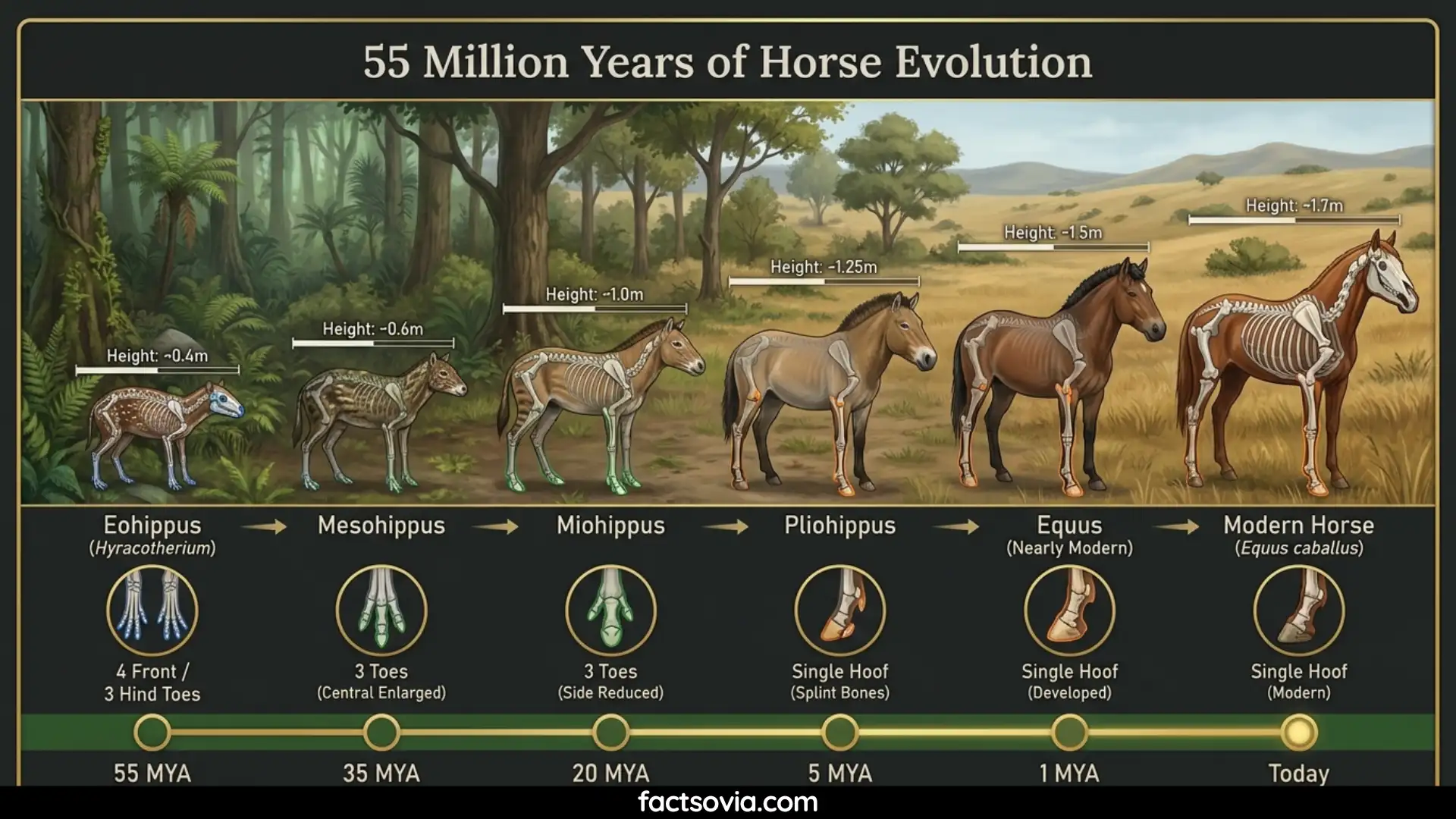
Imagine this: 55 million years ago, your average horse looked nothing like the powerful creatures we see today.
Picture a small, multi-toed animal about the size of a modern dog, scurrying through ancient forests. Sounds unbelievable, right? Yet this is exactly what paleontologists have discovered through fossil records.
The evolutionary journey of horses is one of nature’s most compelling success stories. Over millions of years, these creatures underwent a radical transformation.
Their bodies grew larger, their legs became longer and more powerful, and most dramatically, their multiple toes gradually fused into a single, mighty hoof.
This wasn’t a random change—it was evolution responding to environmental pressures. As grasslands expanded and forests shrank, horses that could run faster and cover greater distances had better survival odds. The result? The sleek, powerful horse we know today.
This transformation is so well-documented that it’s often used as textbook evidence for evolution itself. Each fossil layer tells a story of gradual adaptation, proving that nature is the ultimate architect of change.
Domestication: When Humans Met Horses
Fast forward to around 3500 BC, and humans discovered something revolutionary: horses could be tamed and trained. This wasn’t just a minor development—it fundamentally altered human civilization.
Suddenly, humans had mobility, power, and speed they’d never experienced before. Empires rose and fell on the backs of horses. Wars were won by cavalry charges. Trade routes expanded because merchants could travel faster.
The domestication of horses represents one of humanity’s greatest achievements, ranking right up there with agriculture and the wheel. Without horses, our world would look dramatically different today.
Horse Anatomy: The Engineering Marvel
The Skeletal System: More Than Just Bones
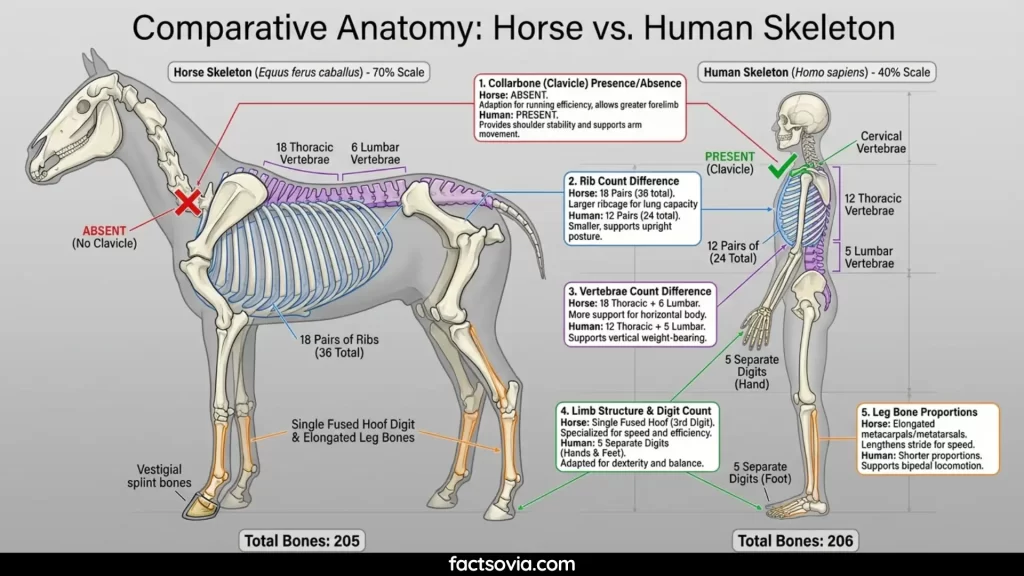
Let’s talk about what’s under that beautiful coat. A horse’s body is an engineering marvel, and it all starts with the skeleton. On average, a horse has 205 bones—that’s about 50 more than humans. But here’s where it gets interesting: horses don’t have a collarbone.
This might sound like a disadvantage, but it’s actually brilliant design. Without a collarbone, a horse’s front legs have greater freedom of movement, allowing for that powerful, extended stride we associate with galloping.
But the real showstopper is the chromosome count: horses have 64 chromosomes. This specific number is crucial for breeding compatibility and genetic diversity. It’s why horses can interbreed with donkeys to create entirely new species—but more on that later.
Why Arabian Horses Are Anatomically Unique
Here’s a fun fact that separates Arabian horses from all other breeds: they’re built differently. While most horses have 18 ribs, Arabian horses have only 17 ribs.
Similarly, they possess 5 lumbar vertebrae (one fewer than other breeds) and 16 tail vertebrae instead of the typical 18.
Why does this matter? These anatomical differences give Arabian horses their distinctive appearance and movement. They’re more compact, more agile, and possess incredible endurance. It’s like comparing a sports car to a sedan—both are vehicles, but they’re engineered for different purposes.
The Eye: Nature’s Panoramic Camera
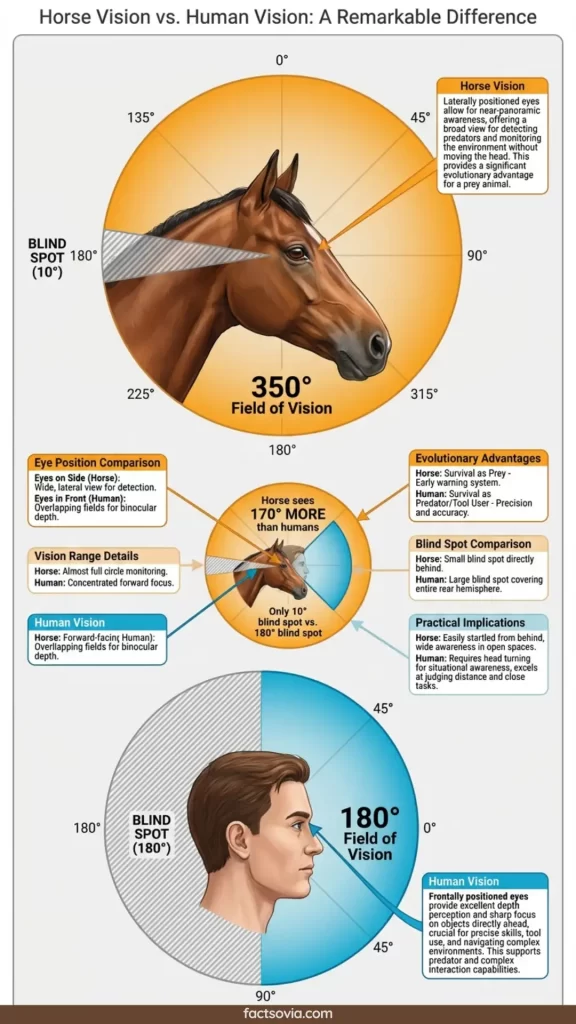
Now, let’s talk about something that will genuinely astound you: horses have the largest eyes of any land animal. But size is just the beginning.
The positioning of their eyes is what’s truly remarkable. Instead of facing forward like human eyes, a horse’s eyes are positioned laterally (on the sides of their head), giving them a 350-degree field of vision.
Think about that for a moment. While you’re limited to roughly 180 degrees of vision, a horse can see almost all the way around without turning its head.
This evolutionary adaptation made perfect sense for prey animals that needed to spot predators approaching from any direction. It’s nature’s surveillance system, built right into their skull.
The Hoof: A Constantly Growing Fingernail
Here’s something that might blow your mind: a horse’s hoof is essentially a giant fingernail. Just like your nails, hooves continuously grow throughout the horse’s life.
For domestic horses, this means they require trimming every 5 to 6 weeks. Neglect this maintenance, and a horse’s hooves can become deformed, causing pain and mobility issues.
Interestingly, horses have 4 toes in their front feet and 3 toes in their back feet—remnants of their evolutionary past when they had multiple toes. Over millions of years, these toes fused into the single powerful hoof we see today.
Horse Behavior and Communication
Movement Types: Walk, Trot, Canter, and Gallop
Most people think horses have one way of moving: galloping. Wrong. Horses actually have four distinct gaits, each with its own rhythm and purpose.
Walk is the slowest and most natural gait—it’s how horses move casually through pastures. Trot is faster, with a two-beat rhythm that’s often bouncy for riders.
Canter is a three-beat gait that feels smoother and more elegant. Finally, gallop is the full-speed sprint, reaching velocities of up to 70 km/h (about 43 mph).
This speed makes horses one of the fastest land animals on the planet. Only a handful of creatures can outrun a galloping horse, and none of them are domesticated.
Imagine the evolutionary advantage this speed provided—it meant survival for wild horses and power for human civilizations.
Sleep Patterns: The Standing Sleeper
Here’s something that seems almost impossible: horses sleep only 2 to 3 hours per day, and they do most of it standing up. Yes, you read that correctly. While you’re enjoying your 7-8 hours of horizontal slumber, horses are catching quick naps on their feet.
Why? This is another evolutionary adaptation. In the wild, lying down makes an animal vulnerable to predators. By sleeping standing, horses can quickly flee if danger approaches.
They have a special locking mechanism in their legs that allows them to rest their weight without muscular effort—it’s like nature’s built-in recliner.
When horses do lie down, it’s only for brief periods, usually just 15-30 minutes at a time. This unique sleep pattern is one reason why horses are such resilient, alert animals.
Herd Dynamics: The Mare-Led Society
Want to know something that challenges traditional assumptions? In wild horse herds, the dominant leader is typically a mare, not a stallion.
This matriarchal structure might surprise those who assume male dominance is universal in nature, but it makes perfect sense.
Mares are the nurturers, the decision-makers, and the ones who know where water and food sources are located.
Horses are intensely social animals. They’re not solitary creatures that happen to tolerate each other—they genuinely need companionship. A horse living alone can experience severe stress and behavioral problems.
In herds, they form deep bonds, communicate constantly, and support each other emotionally. Some horses even form friendships with other species, including humans, dogs, and cats.
Breeding and Reproduction
The Gestation Period Explained
If you’ve ever wondered how long it takes to grow a baby horse, the answer is surprisingly long: approximately 340 days. That’s about 11 months—longer than a human pregnancy.
During this extended gestation period, the foal develops rapidly, preparing for life outside the womb.
Here’s something remarkable: foals are born with legs that are already 90% of their adult length.
This adaptation makes sense evolutionarily—a newborn horse needs to be able to run almost immediately to escape predators.
Most foals are born at night, and within just 1 hour of birth, they can stand and walk. Talk about being ready for the world.
Mules and Hinnies: Hybrid Offspring
This is where things get really interesting. Horses can breed with donkeys, creating entirely new species. But here’s the twist: the offspring’s name depends on which parent is which.
When a male donkey (jack) breeds with a female horse (mare), the result is a mule. When a male horse (stallion) breeds with a female donkey (jenny), the result is a hinny. Both are hybrids, but they’re different animals with different characteristics.
Mules tend to be more common and are prized for their strength and sure-footedness. Hinnies are rarer and often smaller than mules.
The terminology is important: a male horse is called a stallion, a female horse is called a mare, and a newborn is called a foal.
Horse Lifespan and Age Determination
Horses enjoy a relatively long lifespan compared to many animals. The average horse lives 30 to 35 years, with some exceptional individuals reaching their 40s.
This longevity means that horses can form lifelong bonds with their human caretakers—relationships that often span decades.
But here’s something fascinating: you can estimate a horse’s age by examining its teeth. As horses age, their teeth wear down in predictable patterns, and the shape and angle of their teeth change.
Experienced handlers can look at a horse’s teeth and make an accurate age assessment. It’s like reading the rings of a tree—each year leaves its mark.
The Timeless Bond Between Humans and Horses
We’ve journeyed through 55 million years of evolution, explored the intricate anatomy of these magnificent creatures, and uncovered behaviors that challenge our assumptions about animal intelligence and social structure. What emerges is a picture of an animal far more complex, capable, and worthy of our admiration than most people realize.
Horses aren’t just powerful animals—they’re partners in human civilization. They’ve carried us through history, helped us build empires, and continue to enrich our lives through companionship, sport, and therapy. The bond between humans and horses is unique in the animal kingdom, built on mutual respect and understanding.
Whether you’re a lifelong horse enthusiast or someone who’s just beginning to appreciate these animals, one thing is certain: horses deserve our respect, our care, and our wonder. They’re living reminders of nature’s incredible capacity for design, adaptation, and beauty.
The next time you see a horse, take a moment to appreciate the evolutionary marvel standing before you—a creature that’s been shaped by millions of years of natural selection and has chosen, in its own way, to partner with humanity.
Frequently Asked Questions About Horses
How fast can a horse really run?
Horses can reach speeds of up to 70 km/h (43 mph) during a full gallop. However, they can only maintain this top speed for short distances—typically just a few hundred meters. For longer distances, horses settle into a more sustainable pace. This speed makes them one of the fastest land animals on Earth, second only to animals like cheetahs and pronghorn antelopes.
Why can’t horses vomit or burp?
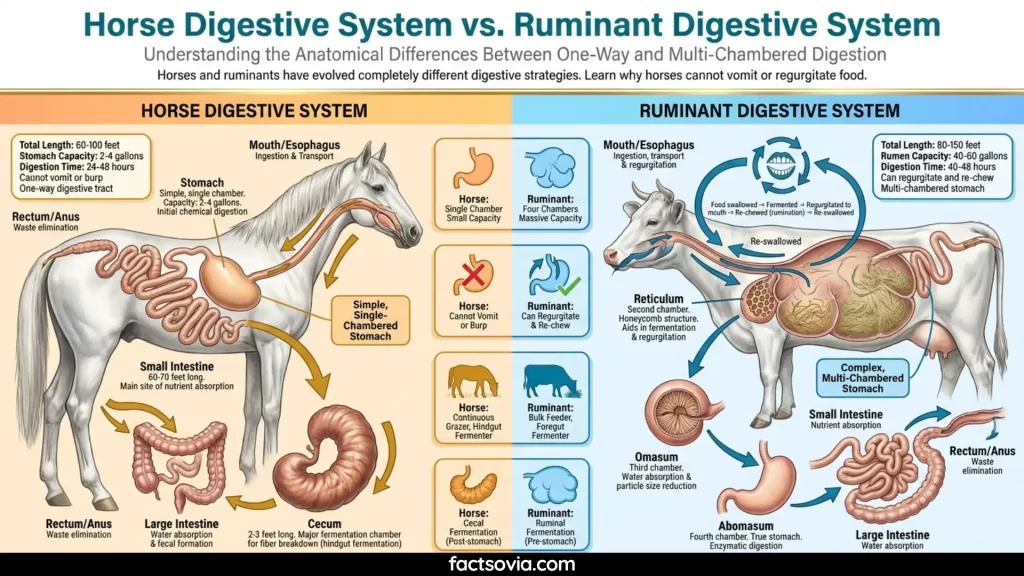
Unlike ruminants (cows, sheep, etc.), horses have a one-way digestive system. Once food reaches their stomach, it can’t come back up. This means horses can’t vomit or burp—their digestive tract is essentially a one-way street. Additionally, horses can’t breathe through their mouths; they’re obligate nasal breathers. This adaptation made sense for grazing animals, but it does mean horses are more susceptible to certain digestive issues.
How many different horse breeds exist?
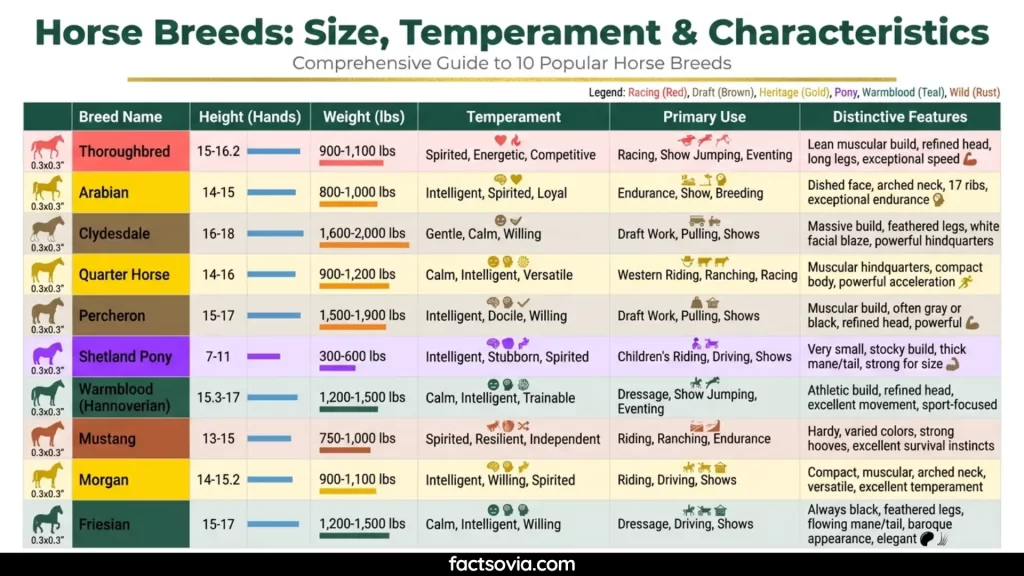
There are approximately 150 different breeds and types of horses found around the world. These range from tiny miniature horses (standing just 34-38 inches tall) to massive draft horses like Percherons and Clydesdales. Each breed was developed for specific purposes—some for racing, others for pulling heavy loads, and still others for specific riding disciplines.
What makes horses such social animals?
Horses are herd animals by nature, and their social structure is deeply ingrained in their psychology. In the wild, horses live in family groups, and this social bonding is essential for their wellbeing. They communicate through vocalizations (neighs, whinnies, snorts), body language, and even touch. A horse living alone can develop behavioral problems like depression, anxiety, and aggression. This is why responsible horse owners always ensure their horses have companionship.
How are horses measured?
Horses are measured in a unit called “Hands”—a measurement that dates back centuries. One hand equals 4 inches. So a horse that stands 16 hands tall is actually 64 inches (about 5’4″) at the shoulder. Horse sizes vary dramatically by breed, ranging from 14 to 18 hands on average, though miniature horses can be much smaller and draft horses can be larger.
Amazon and the Amazon logo are trademarks of Amazon.com, Inc, or its affiliates.
Your info is quite helpful.|
Particularly useful look forward to coming back again.|
Keep up the awesome job !! Lovin’ it!|
Thank you so much for sharing your terrific web-site.|
Great web-site you have in here.|