We use affiliate links to run our site. When you buy through links on our site, we may earn an affiliate commission, without any added cost to you. Learn more
The Quick Answer: What Does Science Tell Us?
Here’s the straight shot: modern Homo sapiens have been walking this planet for roughly 300,000 years. But before you think that’s the whole story, pump the brakes.
That number comes from some of the most compelling fossil evidence ever discovered—specifically, the remains found at Jebel Irhoud in Morocco in 2017. These aren’t just random old bones; they’re the smoking gun that rewrote our understanding of human origins.
Think of it this way: if the Earth’s entire 4.5-billion-year history were a 24-hour day, humans would show up about 17 seconds before midnight. We’re late arrivals, but we’ve made one hell of an entrance.
Why This Question Matters More Than You Think
You might be wondering: why does it matter when humans first appeared? Fair question. Understanding our timeline does more than satisfy curiosity—it fundamentally shapes how we see ourselves, our place in nature, and our future.
When we know where we came from, we better understand our capabilities, our limitations, and our shared humanity. It grounds us in reality. We’re not the product of divine creation happening last Thursday; we’re the result of millions of years of evolution, adaptation, and sheer luck. That perspective changes how we approach global challenges, from climate change to social inequality.
Plus, every time scientists push back the date of human origins or discover a new ancestor, it reshapes our entire evolutionary narrative. That’s not boring stuff—that’s us rewriting our own origin story.
The Homo Sapiens Timeline: When Did We Actually Show Up?
The Jebel Irhoud Discovery: Our Oldest Known Remains
In 2017, researchers published findings that sent shockwaves through the paleontology world. At Jebel Irhoud, a site in Morocco, they uncovered five skulls and associated bones that were dated to approximately 300,000 years ago. Before this discovery, scientists thought modern humans emerged around 200,000 years ago. Suddenly, we had to add another 100,000 years to our history.
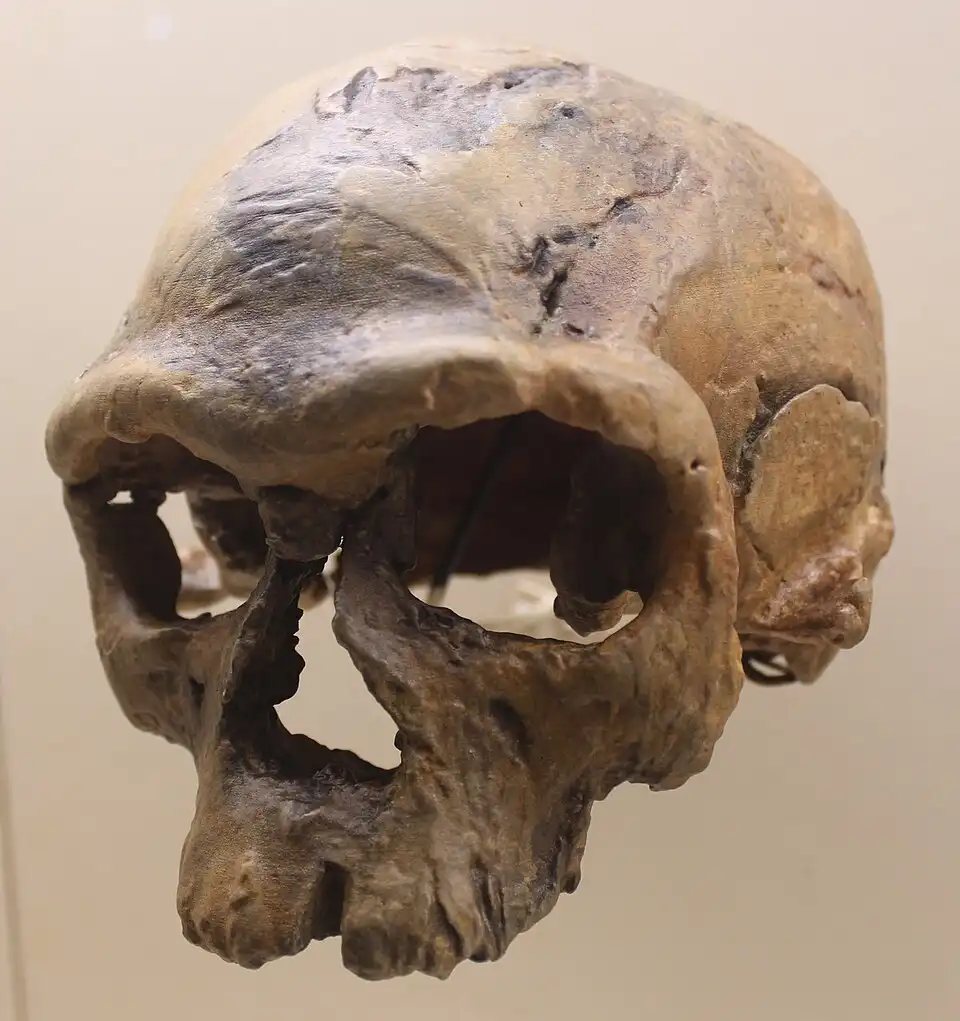
What made this discovery so pivotal? These fossils showed a fascinating mosaic of features. They had modern-looking faces—flatter, more vertical than earlier hominins—but their brains were slightly smaller than ours today. They were unmistakably us, but us in an earlier, slightly different form. It’s like finding your great-great-grandfather’s photo and realizing he looked almost exactly like you, just with a slightly different haircut.
The lead researcher, Jean-Jacques Hublin, described these remains as representing “the oldest known Homo sapiens currently recognized by science.” That’s not speculation; that’s peer-reviewed, published, and widely accepted by the scientific community.
How We Know These Dates Are Accurate
Here’s where skeptics often get stuck: How do we actually know these bones are 300,000 years old? Great question. Scientists use multiple dating methods, and when they all point to the same age range, we can be pretty confident.
Thermoluminescence dating is one key technique. It measures the energy trapped in minerals since they were last heated. By calculating how much energy has accumulated, scientists can determine when those minerals were last exposed to heat. For the Jebel Irhoud fossils, this method consistently pointed to around 300,000 years ago.
Electron spin resonance is another method that measures unpaired electrons in tooth enamel. Again, multiple analyses of different teeth from different individuals all converged on the same age range. When independent methods agree, the confidence level skyrockets.
Think of it like this: if three different people independently solve a math problem and get the same answer, you’re probably looking at the right solution. With fossils, we’ve got multiple “solvers,” and they’re all saying 300,000 years.
Before Homo Sapiens: The Hominin Family Tree
Now here’s where it gets interesting. Homo sapiens didn’t just pop into existence out of nowhere. We had a family tree—a long, branching, sometimes messy family tree.
Australopithecus: Our Distant Cousins (4-2 Million Years Ago)
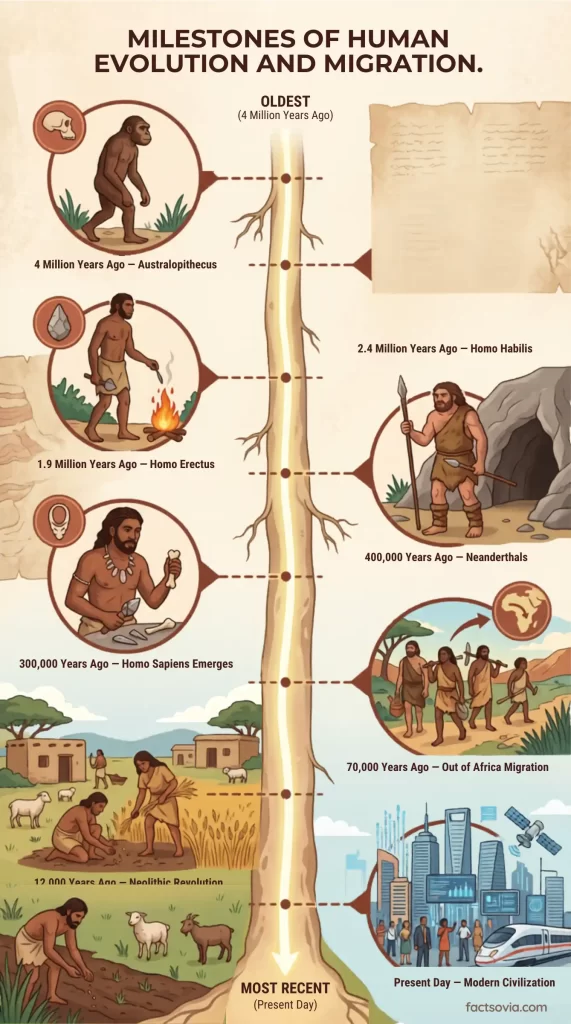
Let’s go way back. Around 4 million years ago, in Africa, creatures called Australopithecus were walking upright on two legs. This was revolutionary. Before them, our ancestors were knuckle-walkers like modern chimps. But Australopithecus said, “Nope, we’re doing this on two feet,” and that changed everything.
Why? Because walking upright freed up your hands. And hands that are free can carry things, make tools, and eventually write poetry. Australopithecus had brains about the size of a modern chimpanzee’s—around 400 cubic centimeters. But they were bipedal, and that was the crucial first step toward becoming human.
The most famous Australopithecus is probably Lucy, discovered in Ethiopia in 1974. She lived about 3.2 million years ago, stood roughly 3.5 feet tall, and walked upright. When researchers first saw her skeletal remains, they realized we’d been wrong about human evolution. We didn’t descend from knuckle-walkers; we had ancestors who chose a different path entirely.
Homo Habilis and Homo Erectus: The Tool Makers
Fast forward to about 2.4 million years ago, and we meet Homo habilis—the “handy man.” This is where things really accelerated. Homo habilis had a bigger brain (around 600 cubic centimeters) and, more importantly, they made tools. Simple stone tools, sure, but tools nonetheless. They could shape rocks into sharp edges for cutting and scraping. That’s not instinct; that’s innovation.
Then came Homo erectus, appearing around 1.9 million years ago. Now we’re talking about a creature that really deserves the name “human ancestor.” Homo erectus had a brain around 900 cubic centimeters, controlled fire, hunted large game, and made increasingly sophisticated tools. They were mobile, adaptable, and smart. Some Homo erectus populations migrated out of Africa and spread across Asia and Europe. They were the first humans to leave the continent.
Neanderthals: Our Misunderstood Relatives
Here’s where the story gets complicated and fascinating. Around 400,000 years ago, in Europe and western Asia, Neanderthals evolved. For a long time, we thought of them as brutish, stupid, and destined for extinction. That narrative was wrong.
Recent research has completely rehabilitated the Neanderthal’s reputation. They had brains as large as ours, they buried their dead (suggesting spiritual or emotional awareness), they made sophisticated tools, they hunted cooperatively, and—here’s the kicker—they interbred with Homo sapiens. If you’re of European or Asian descent, you’ve got Neanderthal DNA in you right now. About 1-4% of your genome comes from them.
Neanderthals didn’t go extinct because they were inferior. They went extinct because Homo sapiens was slightly better adapted, more flexible, and more innovative. It was a slow replacement, not a dramatic conflict. By around 40,000 years ago, Neanderthals were gone, and Homo sapiens was the only hominin species left on Earth.
The Great Migration: When Humans Left Africa
The 70,000-Year Journey That Changed Everything
Here’s a mind-bending fact: every human alive today is descended from a relatively small group of Homo sapiens who lived in Africa somewhere between 70,000 and 100,000 years ago. We’re talking about maybe a few thousand individuals who decided, “You know what? Let’s see what’s out there.”
Around 70,000 years ago, some of these African populations began migrating out of the continent. They crossed into the Middle East, then into Asia, Australia, Europe, and eventually the Americas. This wasn’t a planned expedition with maps and supply lines. This was small groups of people, generation after generation, gradually moving into new territories.
What triggered this migration? Climate change, probably. The Earth was in an ice age, and Africa was getting drier. People followed animals, followed water, followed opportunity. Each generation moved a little further. Over thousands of years, their descendants ended up on every continent except Antarctica.
How Humans Conquered Every Continent
The speed at which humans spread is actually stunning when you think about it. By 60,000 years ago, humans had reached Australia. That required ocean voyages—not long ones, but voyages nonetheless. People had to build boats, navigate, and colonize an entirely new continent.
By 45,000 years ago, humans were in Europe. By 15,000 years ago (some evidence suggests earlier), they’d crossed into the Americas. By 3,000 years ago, they’d reached the most remote Pacific islands. We’re talking about a species that went from a localized African population to a truly global one in just 70,000 years.
What made this possible? Our brains. Homo sapiens had the cognitive flexibility to solve problems, adapt to new environments, create culture, and pass knowledge down through generations. A Homo sapiens transported to a new continent didn’t need millions of years to evolve new traits; they could innovate, adapt, and thrive within a single lifetime.
From Caves to Cities: The Neolithic Revolution
Agriculture Changed Everything (Around 12,000 Years Ago)
For the vast majority of human history—we’re talking 288,000 years—humans were hunter-gatherers. They moved around, followed animal migrations, gathered plants, and lived in relatively small groups. It was a stable, sustainable lifestyle that worked for millennia.
Then, around 12,000 years ago, something shifted. In the Fertile Crescent (modern-day Iraq, Syria, Lebanon, Israel, Palestine, Jordan, and parts of Turkey and Iran), people started deliberately planting seeds. They stopped just collecting wheat and started growing it. They domesticated sheep, goats, cattle, and pigs. Agriculture was born.
This wasn’t a sudden “eureka!” moment. It was gradual. But once it took hold, everything changed. Instead of needing to move to find food, communities could stay in one place and grow their own. Population density increased. You could support more people per square mile with farming than with hunting and gathering.
Why Settlement Led to Civilization
Here’s where it gets interesting. When people settled down, they needed new skills. Someone had to store grain. Someone had to organize labor during harvest. Someone had to settle disputes. Suddenly, you needed leaders, administrators, and specialists.
Settled communities meant:
- Permanent architecture — People built houses that lasted years, not temporary shelters.
- Specialization — Not everyone needed to hunt or farm. Some people could be potters, toolmakers, or priests.
- Trade — Communities could exchange surplus goods with neighbors.
- Writing — As societies grew complex, people needed to keep records. Writing emerged.
- Government and law — Larger groups needed rules and enforcement.
- Religion and culture — Shared beliefs and artistic traditions flourished.
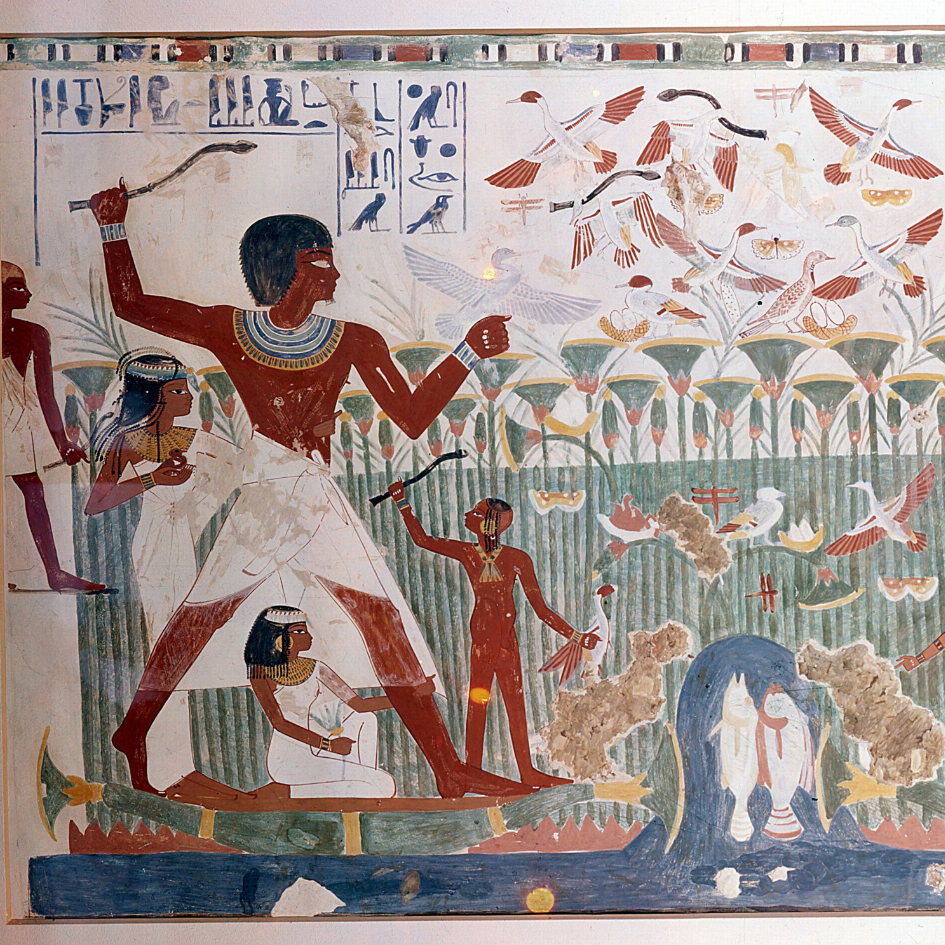
Within a few thousand years of agriculture’s emergence, we had cities. By 3000 BCE, we had the Egyptian and Sumerian civilizations. By 2000 BCE, we had the Indus Valley Civilization. By 1500 BCE, we had the Shang Dynasty in China.
In just 10,000 years—a blink of an eye in evolutionary terms—we went from scattered farming villages to complex, literate, hierarchical societies. We invented writing, mathematics, law, art, philosophy, and science. We built pyramids, temples, and palaces. We created governments, religions, and wars.
All of that emerged from the simple decision to plant seeds instead of just picking them.
Conclusion: Understanding Our Place in Time
So, to circle back to the original question: How long have humans been on Earth? The answer is 300,000 years for Homo sapiens specifically. But if you zoom out and include our broader hominin ancestors, we’re talking about a journey that spans millions of years.
What’s remarkable isn’t just the length of that journey—it’s the acceleration. For 288,000 years, we were hunter-gatherers. Then, in the last 12,000 years, we built civilization. In the last 500 years, we’ve gone from sailing ships to space travel. In the last 50 years, we’ve gone from room-sized computers to AI that can write essays.
We’re a species that evolves culturally at an astonishing rate. Our biological evolution is slow, but our technological and cultural evolution is explosive. That’s our superpower.
Understanding this timeline also reminds us that we’re all connected. Every human alive today shares a common ancestor who lived in Africa within the last 100,000 years. Your DNA carries echoes of Neanderthals, Homo erectus, and creatures we haven’t even discovered yet. We’re not separate from nature; we’re part of it. We’re not the end point of evolution; we’re just the current chapter.
And here’s the thing: knowing where we’ve come from should inform where we’re going. We’ve survived ice ages, migrations, competition with other species, and the complete restructuring of our societies. We’ve shown remarkable resilience and adaptability. As we face modern challenges—climate change, social division, technological disruption—that history should give us confidence. We’ve overcome challenges before. We can do it again.
Frequently Asked Questions
1. How long have modern humans (Homo sapiens) existed?
Modern Homo sapiens have existed for approximately 300,000 years, based on fossil evidence from Jebel Irhoud in Morocco and confirmed through multiple dating methods, including thermoluminescence and electron spin resonance dating. This represents a significant revision from earlier estimates of around 200,000 years.
2. What’s the difference between Homo sapiens and other hominins like Neanderthals?
While Neanderthals and Homo sapiens coexisted for thousands of years and even interbred, Homo sapiens had slightly larger brains, greater behavioral flexibility, and superior adaptability to new environments. Neanderthals went extinct around 40,000 years ago, while Homo sapiens continued to thrive and eventually populated every continent.
3. When did humans first leave Africa?
Humans began migrating out of Africa approximately 70,000 to 100,000 years ago. This gradual dispersal took thousands of years, with humans reaching the Middle East by 60,000 years ago, Australia by 60,000 years ago, Europe by 45,000 years ago, and the Americas by 15,000 years ago (with some evidence suggesting earlier dates).
4. How did the Agricultural Revolution change human civilization?
Around 12,000 years ago, the transition from hunting and gathering to agriculture allowed permanent settlements, population growth, and specialization of labor. This led to the development of cities, writing systems, governments, trade networks, and complex societies—essentially creating the foundation for modern civilization.
5. How do scientists know the age of ancient human fossils?
Scientists use multiple dating methods to determine fossil age with high confidence. Thermoluminescence measures energy trapped in minerals since they were last heated, while electron spin resonance measures unpaired electrons in tooth enamel. When multiple independent methods converge on the same age range, scientists can be highly confident in the dating.
Amazon and the Amazon logo are trademarks of Amazon.com, Inc, or its affiliates.